
Nordic walking relies on a continuous transfer of muscular effort through the upper body into the ground via specialized poles. In standard walking or trekking pole usage, the hand remains closed around the grip to maintain physical possession of the shaft. Nordic walking alters this mechanical relationship by utilizing an ergonomic harness strap that attaches directly to the wrist and base of the hand. During the propulsion phase, when the arm swings behind the torso to drive the walker forward, maintaining a closed grip restricts shoulder extension and places unnatural torque on the carpal joint. To achieve a full arm extension and generate continuous backward pressure, the walker must open the fingers and release the rigid grip on the pole handle.
Managing the hand release requires precise neuromuscular timing and correct equipment adjustment. If the release occurs too early, propulsion is lost before the pole tip achieves solid purchase in the ground. If the release occurs too late, the wrist flexes sharply upward, restricting the stride and overloading the forearm musculature. This guide details the mechanical role of the harness strap, the exact positional triggers for releasing the fingers behind the pelvis, methods to avoid muscle fatigue, practical field drills, and sizing adjustments for different hand profiles.
The Role of the Harness Strap in Force Transfer
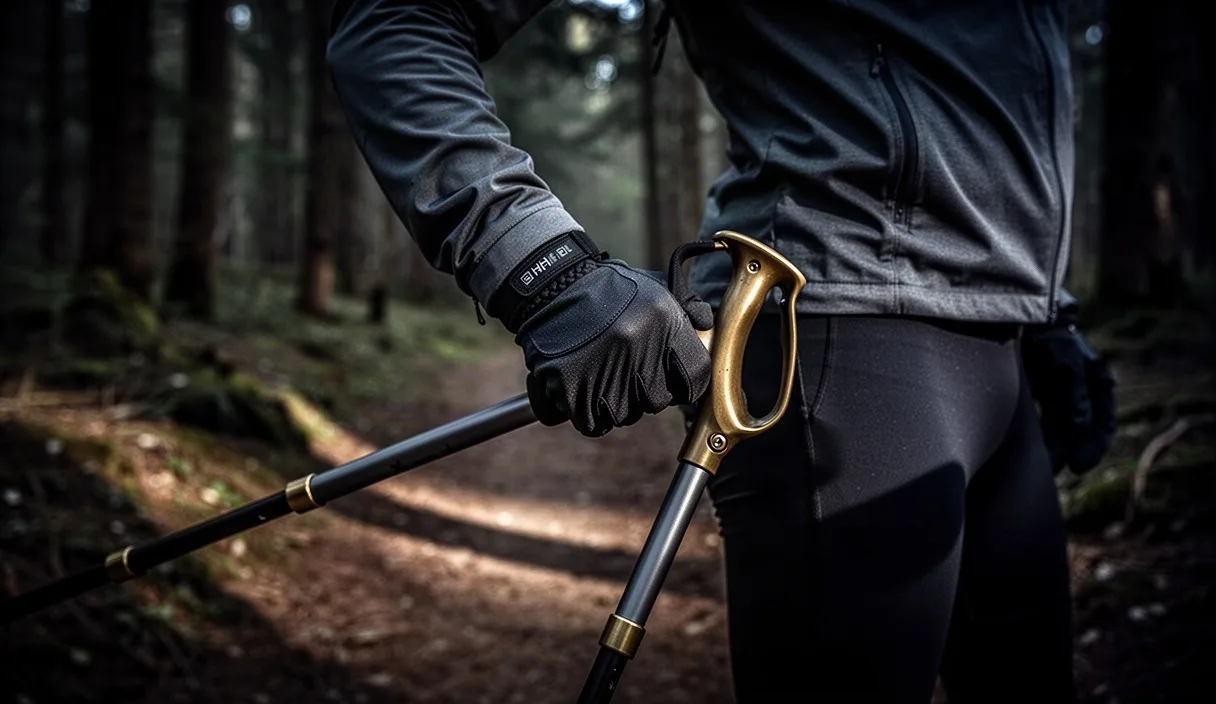
The harness strap, commonly referred to as a gauntlet or mesh strap, acts as the primary mechanical link between the upper limb and the pole. It encircles the wrist and wraps across the hypothenar eminence (the muscular bulge at the base of the little finger) and the thenar eminence (the base of the thumb). A central loop or wedge passes between the thumb and index finger to fix the strap securely to the top of the handle. When fitted correctly, this arrangement transfers backward muscular force directly from the radius and ulna through the strap fabric, bypassing the small flexor tendons of the fingers entirely.
Without the harness, a walker must squeeze the rubber or cork grip tightly to transfer force down the shaft. Gripping with the fingers activates the flexor digitorum superficialis and flexor digitorum profundus muscles in the anterior compartment of the forearm. Sustained isometric contraction of these muscles over several kilometers reduces blood circulation, accelerates localized fatigue, and limits the range of motion at the glenohumeral joint. By redirecting the load path through the skeletal structure of the forearm and into the strap material, the harness permits propulsion even when the fingers are completely straight.
| Propulsion Factor | Closed-Hand Trekking Style | Open-Palm Nordic Style |
|---|---|---|
| Primary Force Contact | Distal and middle phalanges | Wrist strap and palm base |
| Active Forearm Muscles | Continuous flexor contraction | Alternating flexor-extensor cycles |
| Shoulder Extension Range | Limited to roughly 15 to 20 degrees behind hip | Extended to 35 to 45 degrees behind hip |
| Pole Angle at Release | Maintained vertically or forward | Consistent backward angle of roughly 45 degrees |
| Wrist Joint Posture | Flexed upward at stroke end | Neutral, linear alignment with forearm |
The force transfer vector remains most efficient when the strap fits snugly against the dorsal surface of the hand without restricting capillary refill. The tension should be distributed evenly across the palm base so that rearward pressure pushes the pole shaft backward and downward at an angle between 40 and 50 degrees relative to the ground surface. If the strap is too loose, the hand slides backward inside the fabric before engaging, resulting in lost mechanical energy and skin friction that can lead to blisters.
Timing the Open Palm Behind the Pelvis
The propulsion phase begins when the pole tip contacts the terrain roughly level with the heel of the opposing foot. At the moment of plant, the hand holds the grip lightly to guide the tip into position. As the torso moves forward over the planted pole, the walker depresses the shoulder and pulls the elbow downward, applying downward and backward pressure. The transition from a closed grip to an open palm occurs precisely as the hand passes the coronal plane of the body, which aligns with the anterior superior iliac spine of the pelvis.
Opening the hand earlier than the pelvic line causes the pole to skid across the ground surface because downward vector force is insufficient to maintain tip grip. Opening the hand later forces the wrist into severe ulnar deviation and hyperflexion, which pinches the median nerve within the carpal tunnel and shortens the propulsive stroke. The sequence unfolds through three distinct geometric checkpoints:
- Pelvic Transition: As the thumb knuckle passes the midline of the hip bone, the distal phalanges uncurl from the rubber grip. The thumb remains close to the index finger, but the grasp slackens.
- Mid-Release: When the arm reaches roughly 20 degrees of extension behind the hip, the palm opens fully. The palm faces slightly inward toward the thigh, and the base of the hand presses firmly against the wide lower band of the harness strap.
- Full Extension: At terminal extension, the shoulder reaches approximately 40 degrees of extension, forming an unbroken diagonal line from the shoulder joint down through the triceps, forearm, strap, and pole tip. The fingers point diagonally backward and downward, completely relaxed.
Once terminal extension is achieved, the propulsive push ends. The walker releases backward pressure against the strap, initiates an anterior swing from the shoulder, and draws the pole forward. As the pole swings forward past the hip line, the fingers naturally close around the grip again to stabilize the shaft before the next plant. The forward recovery relies entirely on the natural rebound of the pole suspended from the wrist strap, requiring zero muscular effort to drag the pole forward.
Preventing Forearm Cramping Caused by Over-Gripping
Forearm cramping during sustained Nordic walking almost always stems from the failure to enter the rest phase of the muscular cycle. In proper technique, the finger flexors contract lightly for approximately 0.4 seconds during the forward plant, then relax for roughly 0.6 seconds during the release and recovery swing. When a walker maintains a tight grip throughout the entire stride, the muscle tissues experience uninterrupted mechanical tension, restricting venous drainage and causing lactic acid accumulation.
Over-gripping frequently occurs as an involuntary defensive reflex. Walkers unfamiliar with harness systems subconsciously fear dropping the pole on asphalt or uneven ground. To interrupt this reflex, the walker must systematically test the integrity of the harness while standing still. Leaning backward against the straps while holding the arms behind the body confirms that the poles will support substantial body weight without the fingers touching the handles at all.
If persistent forearm pain or tightness develops during or after training sessions, the walker should check for mechanical indicators of nerve irritation or chronic tendon strain. Persistent numbness in the thumb, index, or middle fingers may indicate carpal tunnel irritation from excessive wrist flexion. Walkers experiencing flexibility & mobility or unresolved paresthesia should consult a qualified physical therapist or sports medicine physician for an individualized diagnostic evaluation.
Coordination Drills for Fluid Hand Opening
Neuromuscular patterning requires conscious repetition to override the natural instinct to grasp a moving tool. The following drills isolate the components of the hand release without the complexity of managing variable terrain.
Drag and Swing Drill
This drill establishes confidence in the harness strap and eliminates active finger recruitment during the recovery phase.
- Attach the poles to the harness straps securely, but do not touch the plastic or cork handles with your fingers. Let your arms hang vertically at your sides.
- Begin walking forward at a normal cadence. Allow the pole shafts to drag along the ground behind you at a low angle.
- Gradually increase the natural swing of your arms from the shoulders. Keep your hands fully open with relaxed, straight fingers pointing toward the ground.
- Notice how the straps pull the poles forward automatically during the anterior swing. Continue this dragging action for 300 meters to reinforce passive pole recovery.
Pelvic Tap Cue
This exercise establishes the precise physical marker for when the release must occur.
- Hold the pole grips lightly while walking at a moderate pace of roughly 4 to 5 kilometers per hour.
- As each hand swings backward, lightly brush the outer fabric of your trousers at the level of the hip bone with the tip of your thumb.
- Use this physical contact as an explicit command to extend the fingers completely.
- Maintain the open palm until the rear arm reaches full extension, then allow the fingers to close as the hand swings forward past the thigh. Repeat for 50 strides per side.
Two-Finger Guidance Drill
This variation reduces grip strength during the initial plant phase, making the backward transition to an open hand easier to execute.
- Assume standard walking posture with poles planted at a 45-degree angle.
- Hold the grip using only the thumb and the index finger, lifting the middle, ring, and little fingers completely off the handle.
- Execute the plant and initial propulsive drive using only this two-finger contact.
- As the hand reaches the hip line, release the thumb and index finger, transferring all remaining propulsive force to the strap.
- Practice this drill for intervals of 2 minutes, followed by 2 minutes of standard technique, over a total duration of 16 minutes.
Adjusting Strap Tension for Varying Hand Dimensions
A hand release cannot function smoothly if the strap dimensions are incorrect for the user's hand size. Most quality Nordic walking poles feature asymmetrical left and right straps marked with distinct indicators. These straps include an adjustable hook-and-loop closure across the back of the hand and sometimes a secondary adjustment buckle near the wrist anchor.
When measuring fit, the critical dimension is the distance between the anchor wedge at the top of the pole grip and the lower strap cradle that supports the hypothenar border. If this distance is too long, the palm sits several centimeters below the grip, forcing the walker to reach upward to catch the handle on the recovery phase. If the distance is too short, the strap pinches the skin web between the thumb and index finger, restricting the blood supply to the digital arteries.
| Hand Profile | Circumference at Metacarpals | Recommended Strap Setting | Adjustment Precaution |
|---|---|---|---|
| Small / Slender | Under 185 mm | Tightened fully across dorsum; minimal anchor slack | Ensure thumb channel does not bunch against grip |
| Medium Standard | 185 mm to 215 mm | Centered alignment; hook-and-loop overlaps by at least 40 mm | Verify palm wedge rests directly over hypothenar pad |
| Large / Broad | Over 215 mm | Extended dorsal strap; maximum anchor loop clearance | Confirm wrist closure does not constrict ulnar artery |
| Winter Glove Use | Adds roughly 15 to 25 mm | Expand dorsal strap by one full index interval | Check that glove material does not catch on grip release wedge |
To verify the setting, slide the bare hand into the harness and secure the hook-and-loop closure. Open the fingers completely and let the arm hang straight down. The pole should hang suspended against the palm, with the top of the handle touching or sitting within 5 millimeters of the skin fold between the thumb and forefinger. Next, extend the arm straight backward as if at the end of a stroke. The strap should lie flat against the palm base without tilting the pole shaft sideways. If the shaft twists outward, the dorsal strap tension is asymmetric and must be centered.
Common Mistakes
Deviations in hand release mechanics reduce propulsion efficiency and increase joint stress. Correcting these errors requires recognizing their distinctive physical symptoms during movement:
- Dorsal Wrist Flick: The walker opens the hand behind the hip but violently extends the wrist backward toward the forearm. This habit isolates the extensor digitorum and carpal ligaments under load. The wrist must remain in a neutral, straight alignment with the forearm bones throughout the entire release.
- Premature Finger Opening: The fingers open while the hand is still in front of the torso or directly beside the navel. This breaks the downward plant angle, causing the pole carbide tip or rubber pad to slip forward across the pavement.
- Throwing the Pole: The walker actively flings the pole backward by straightening the fingers with explosive force, rather than simply uncurling the digits and allowing momentum and strap tension to dictate pole travel. This introduces instability into the forward recovery arc.
- Choking the Grip: The fingers remain wrapped around the handle until the end of the stroke, causing the elbow to bend upward behind the back like a chicken wing. This eliminates the mechanical advantage of the latissimus dorsi and triceps muscles, transferring excessive load to the anterior deltoid.
Practical Next Steps
Refining the hand release requires progressive integration during regular training sessions. Walkers should begin on a flat, even surface such as packed gravel or an asphalt track, which provides reliable tip traction and eliminates balance variables caused by uneven terrain.
Begin the next three training sessions with 5 minutes of static checks. Stand in place, secure the straps, and practice swinging the arms between neutral hip height and terminal extension behind the pelvis. Confirm that the fingers relax naturally as the hand crosses the hip seam of your clothing. Progress directly into 10 minutes of the Drag and Swing drill to clear residual grip tension before establishing standard cadence.
Incorporate video feedback where feasible. Have an observer record a 15-second side profile clip of your stride at normal walking speed. Review the footage specifically to evaluate wrist alignment at terminal extension: if the line through the forearm and hand breaks upward, focus the next session on maintaining an open, downward-pointing palm. For persistent movement pattern difficulties or structural pain, schedule a biomechanical consultation with an accredited Nordic walking instructor or sports physiotherapist.